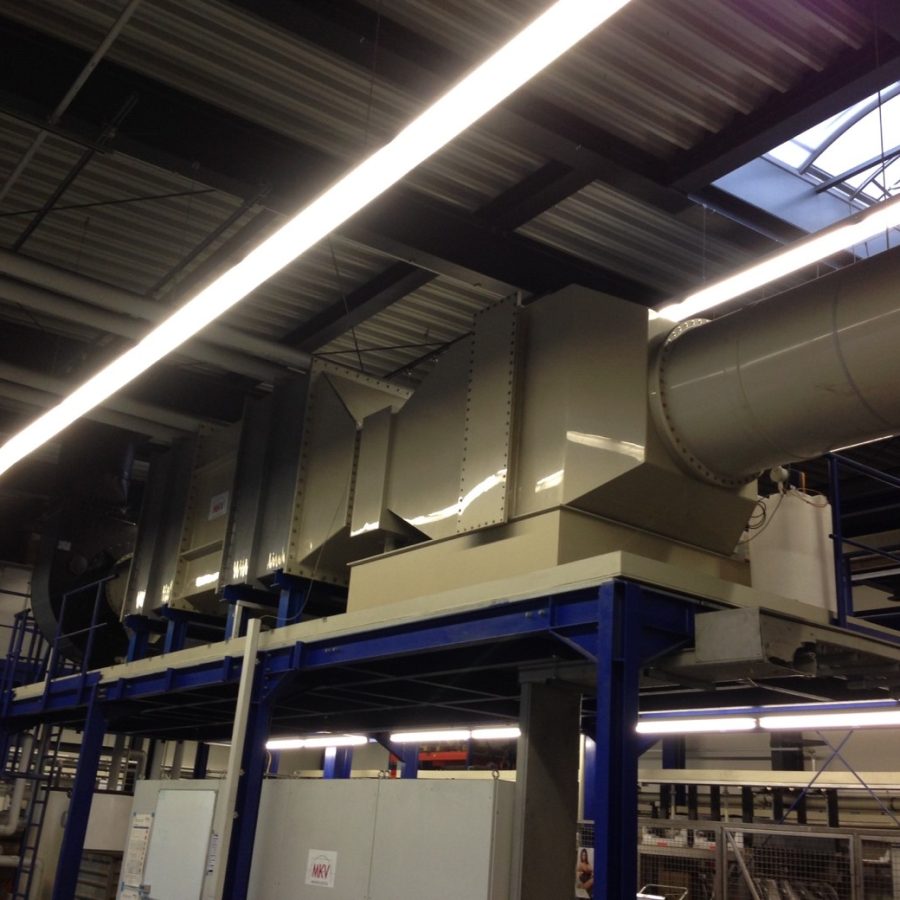
Case Study #10: KVS System for Heat Recovery in Electroplating Shops
Initial situation
In electroplating operations, maintaining air quality standards, such as MAG values, requires removing fumes and vapor from open process tanks. These airborne contaminants are extracted from the work environment and cleaned in a scrubber system. Simultaneously, fresh outdoor air is introduced into the facility, which must be preheated during colder months.
However, the exhaust air from the electroplating process contains valuable thermal energy that is typically lost. A circulation system can capture this waste heat and reuse it to preheat the incoming air, improving energy efficiency.
Challenge
Combining exhaust air from multiple tanks results in a complex chemical mix, making it difficult to predict long-term effects on heat exchanger materials. While some of the exhaust is neutralized in the scrubber, residual corrosive particles may remain. Stainless steel exchangers are vulnerable to corrosion, and coated exchangers are unreliable once the coating is damaged. A solution is needed that is:
-
Fully corrosion-resistant
-
Durable against unknown chemical exposure
-
Capable of high thermal efficiency
Solution
Calorplast provided a gas-to-liquid heat exchanger constructed entirely from high-performance solid plastic. Key features include:
-
Welded components with no seals or gaskets
-
Smooth, modular tube design for easy cleaning and maintenance
-
Optimized tube layout for maximum heat transfer
-
Proven resistance to aggressive gas mixtures

Result
The KVS system operates reliably for many years with minimal maintenance. In addition to meeting strict air quality standards, the facility benefits from significant energy savings through heat recovery and a measurable reduction in CO₂ emissions. Calorplast’s solution offers long-term performance with low total cost of ownership.