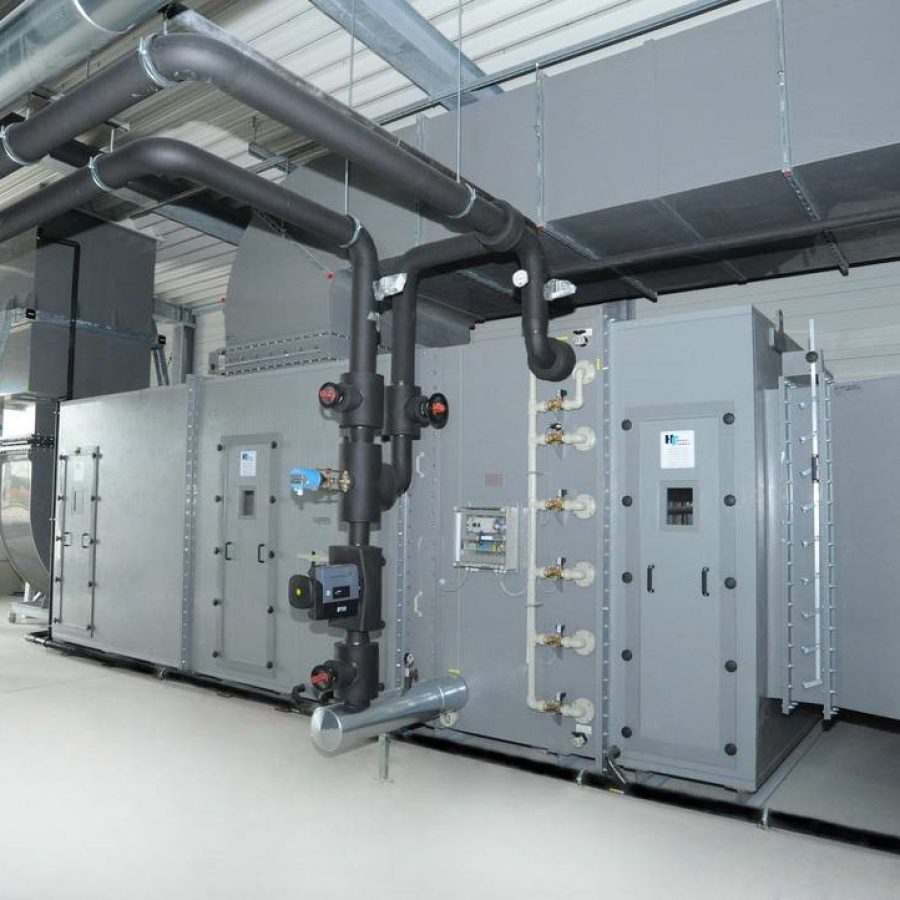
Case Study #2: Corrosion-Resistant Heat Recovery for Laboratory Ventilation Systems
Initial situation
In modern laboratory buildings, ventilation systems must not only comply with strict regulatory standards but also provide reliable heat recovery. For systems requiring complete separation of supply and exhaust airflows, a circulating coolant system (CCS) is the solution of choice. CCS systems transfer heat via a liquid medium between completely isolated supply and exhaust air heat exchangers—eliminating cross-contamination.
In labs, this is critical, as toxic and corrosive vapors from fume hoods and workspaces must never re-enter the supply air stream.
Challenge
Traditional metal or coated air/water heat exchangers are vulnerable to chemical degradation, especially when exposed to unknown or varying concentrations of corrosive agents. The customer needed a fully corrosion-resistant, long-lasting heat exchanger capable of withstanding unpredictable chemical exposure while maintaining thermal efficiency in a high-performance laboratory ventilation system.
Solution
Calorplast supplied a gas-to-liquid heat exchanger made entirely from solid, high-performance plastic. Key features include:
-
Welded, seal-free construction – no risk of seal failure
-
Replaceable modular design for easy servicing
-
Smooth tube geometry to reduce fouling and optimize flow
-
Chemical resistance to aggressive, volatile compounds
This design ensures maximum durability and performance in chemically aggressive ventilation environments.

Result
The heat recovery system (HRV/WRG) now operates reliably and safely for decades, requiring minimal maintenance while protecting personnel and maintaining compliance. The Calorplast solution ensures the planned return on investment and helps create a safer, energy-efficient lab environment.